


AI & the HR Operating Model
An Articul8 Research Series · Chris Long, Elev8 Group

Agentic AI is not adding pressure to the HR operating model. It is dismantling the structural logic on which that model was built. This research series maps what is ending, what replaces it, and what workforce leaders need to do next.
1 Master Research Paper · 4 Research Briefs · 1 Anchor Research Note · 8 Research Notes · 1 Visual Framework
The Argument in One Sentence
Agentic AI is not accelerating the automation of HR processes. It is forcing a structural reconception of what HR is for — and most HR functions are not yet building for it.
The Argument
Every significant technology shift in enterprise HR has arrived with the same promise: this time, the function will be transformed. HRIS platforms would free HR from paper. Shared Services would free Business Partners to focus on strategic work. Analytics would make HR evidence-led. Each promise was partially correct and systematically overstated. And each left the HR operating model structurally intact — because every technology that came before agentic AI automated tasks within the existing model without threatening the logic on which it rested.
Agentic AI is different. Not because the transformation narrative is more credible — at this stage of deployment, it is arguably less evidentially grounded than its predecessors. It is different because the mechanism of disruption is different. Previous automation waves removed effort from within the existing structure. Agentic AI removes the rationale for structural units within it.
The argument this Note makes is precise: agentic AI is not accelerating the automation of HR processes. It is forcing a structural reconception of what HR is for. The function that survives in an AI-native operating environment is not one that has automated its existing processes. It is one that has reconceived its primary purpose — from process execution and administrative coordination toward the governance, interpretation, and strategic orchestration of human-machine workforce systems.
That is not an incremental shift. And most HR functions are not yet building for it.
The Mechanism
To understand why agentic AI disrupts the HR operating model structurally rather than incrementally, two AI paradigms — routinely conflated in practitioner discourse — need to be clearly distinguished.
Generative AI functions as a creator. It produces content in response to a prompt and stops. Its value is additive: it reduces the time required to draft a job description, summarise a performance review, or respond to an employee query. A human still orchestrates between steps. A human still decides what to do with the output. Generative AI makes existing workflows faster. It does not change their logic.
Agentic AI is categorically different. It plans. It executes sequences of actions across extended timeframes. It uses external tools — databases, APIs, communication systems — to accomplish goals that require multiple steps and real-time adaptation. It can operate with minimal human intervention between initiation and completion. The difference is not one of degree. It is a difference in kind.
The implication for HR is specific. Previous automation required human orchestration between every meaningful step. Agentic AI breaks this dependency entirely. An agent that can source candidates, screen applications, schedule interviews, generate offer letters, complete onboarding workflows, and respond to employee queries throughout that process does not require a Shared Services function to coordinate between steps. The coordination is built into the agent. The handoffs are internal to the system.
McKinsey/QuantumBlack's retrospective on fifty-plus agentic AI production deployments confirms that organisations deploying agents into end-to-end workflows are not making existing HR structures more efficient. They are making entire coordination layers structurally redundant. The question is not whether this is happening. It is whether your operating model is being designed for the world in which it is.
What the Three-Pillar Model Was Built On
To understand what agentic AI disrupts, you have to understand what the existing HR operating model was designed to do.
The three-pillar HR model, first codified by Dave Ulrich in 1997, rests on three structural assumptions. Each one justified a layer of the model. Each one is now under simultaneous pressure — and the coincidence of all three eroding at once is what makes this disruption structural rather than incremental.
The first assumption: information asymmetry. HR holds expertise that line managers and employees lack — in employment law, talent data, L&D methodology, and compensation benchmarking. That asymmetry justified specialist roles: Business Partners, Centres of Excellence, Shared Services. When an AI agent can answer a complex employment law query, surface internal candidates using a live skills graph, or benchmark a compensation offer against real-time market data, the information asymmetry that justified those roles narrows. Not eliminates. Narrows. But the narrowing is structural.
The second assumption: transaction volume as a structural rationale. Shared Services exist because the volume of transactional HR activity — onboarding, payroll queries, benefits administration, leave management — justifies dedicated capability. The volume built the structure. When agentic systems complete those workflows end-to-end rather than supporting human handlers, the structural case for Shared Services in its current form weakens. The volume that built the function is no longer a justification for its size or shape.
The third assumption: complexity requires human synthesis. Centres of Excellence exist because talent strategy, leadership development, and organisational design require deep expertise and human judgement to synthesise inputs into coherent policy. This is the most durable assumption — and the one most likely to survive in some form. But even here, when AI agents can analyse engagement data across thousands of employees, model workforce scenarios, and generate strategic recommendations, the CoE professional's role shifts — from analysis and synthesis toward interpretation, governance, and decision authority. The work does not disappear. What the work is changes fundamentally.
Three assumptions. All three are eroding simultaneously. TI People's AI-Powered HR research makes this explicit: the traditional three-pillar model will not survive AI intact. Significant rearchitecting is required. Not an incremental adjustment. Rearchitecting.
What Replaces It
If the three-pillar model's logic is eroding, the question is operational: what does the function look like when the assumptions that built it no longer hold?
The honest answer is that no organisation has fully solved this yet. The evidence base is rich in mechanisms and thin on outcomes. But the direction is consistent across the most credible sources in the field. HR's primary organisational value shifts from process execution and administrative coordination toward the governance, interpretation, and strategic orchestration of human-machine workforce systems. These three capabilities are the new centre of gravity for the HR operating model.
Governance. When AI agents participate in workforce-affecting decisions — sourcing candidates, assessing performance, allocating tasks, managing onboarding — someone has to design the delegation boundaries, monitor outputs, manage failure modes, and remain accountable for outcomes. That is HR's work. It is not the HR work of the last twenty years. But it is unmistakably a people-function responsibility — and in European contexts, the EU AI Act converts it from best practice to a legal obligation.
Interpretation. AI systems surface patterns, recommendations, and predictions at a scale and speed that human analysts cannot match. But pattern recognition is not judgment. The premium shifts to the human who can interpret what the system surfaces, challenge it where it is wrong, integrate it with organisational context, and translate it into decisions that account for what the data cannot see. That interpretive capability is the new centre-of-excellence value proposition.
Orchestration. The enterprise is becoming less a hierarchy of roles and more an ecosystem of humans, systems, workflows, and agents. Workforce planning, job architecture, role design, and capability development all have to be rebuilt around the question of which processes are human-led, which are AI-augmented, and which are AI-powered. That is an HR operating model problem — and it requires a quality of analytical thinking that the dominant consulting and vendor literature has not yet supplied.
The organisations that treat this as a technology adoption challenge will consistently underperform those that treat it as an operating model design challenge. That distinction is the difference between capturing value and bearing cost without return.
What This Changes for Leaders
The structural argument above is not abstract for a senior HR leader. It lands in your function, your team, your budget, and your conversations with your CEO. Four things follow directly.
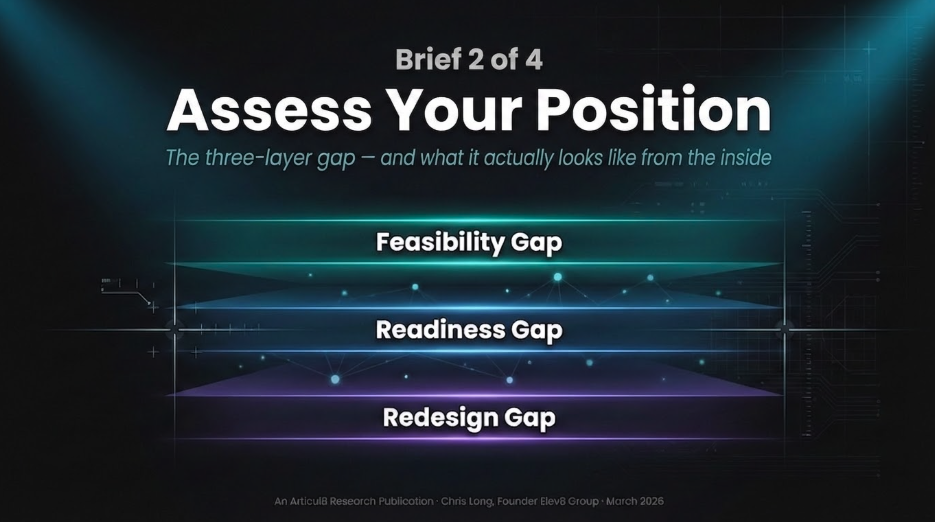
You are probably further from value than your activity metrics suggest. The metrics most organisations are using — tools deployed, pilots completed, use cases identified — measure motion, not position. There is a three-layer gap between what AI can technically do, what organisations are deploying, and where deployment is actually generating value. Most HR functions are sitting inside it without knowing which layer they are in.
Brief 2 — Assess Your Position — maps the gap and provides a diagnostic lens to locate yourself.
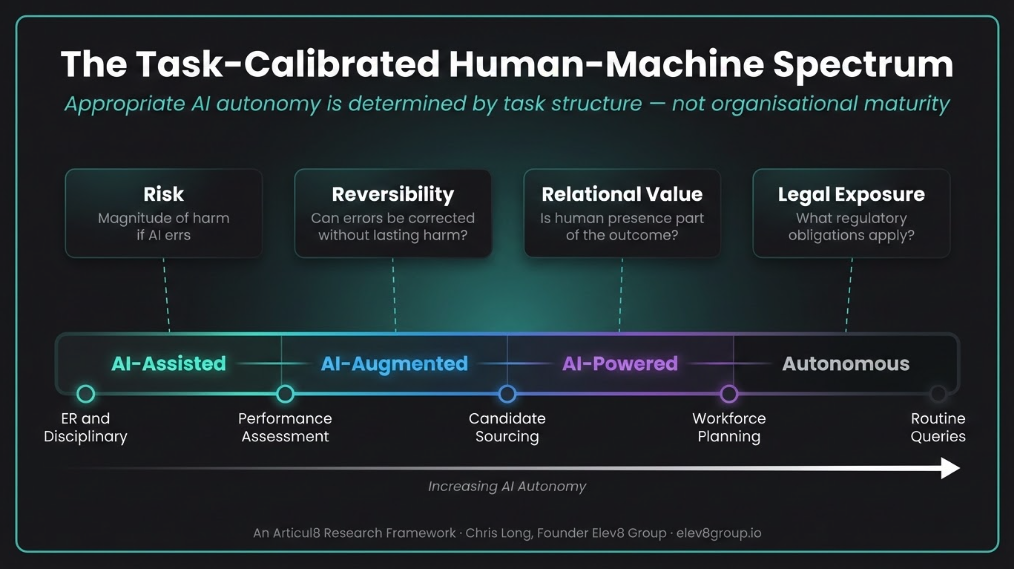
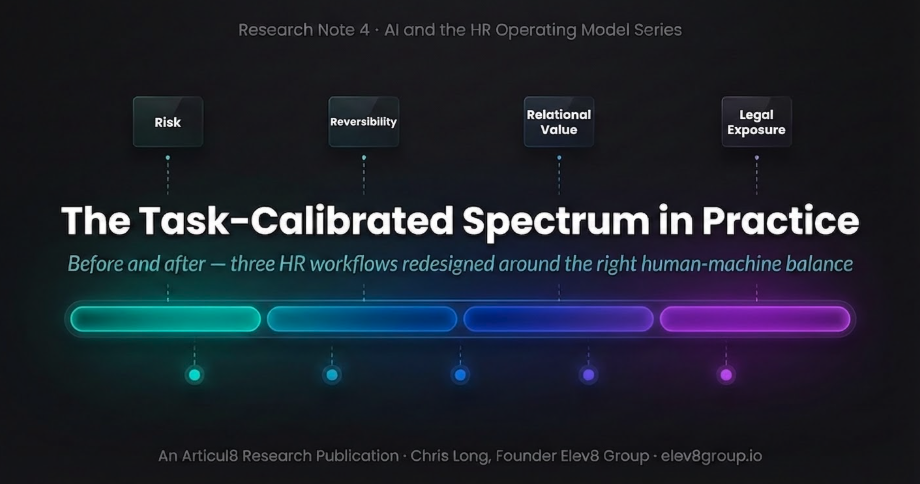
You need a task-calibrated framework, not a maturity ladder. The most common error in AI operating model design is treating human-machine balance as a function of organisational maturity. The appropriate degree of AI autonomy in any HR process is a function of task structure — its risk, reversibility, relational value, and legal exposure. The errors the maturity model produces are predictable: over-automating high-stakes processes and under-automating low-stakes ones.
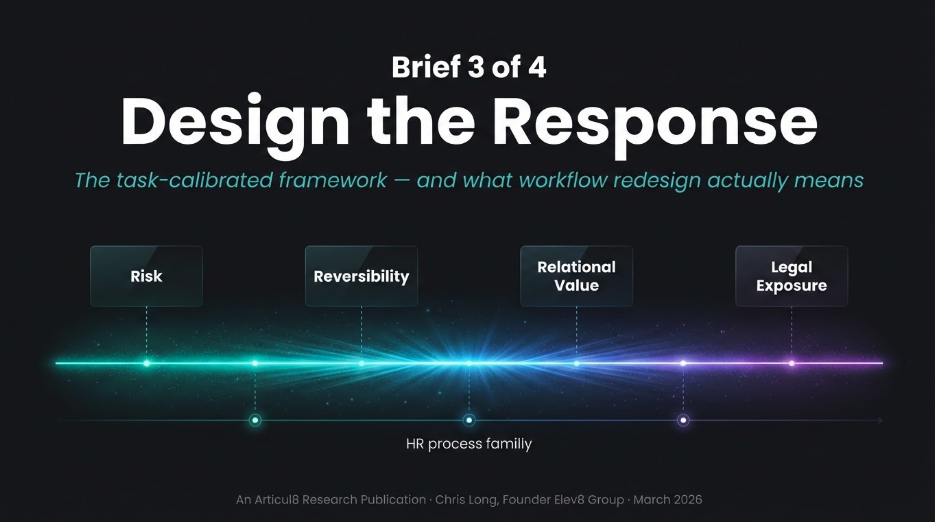
Brief 3 — Design the Response — delivers the framework and applies it to five HR process families.
The EU AI Act and related regulations are design constraints, not compliance layers. The EU AI Act has classified AI systems used in recruitment, performance monitoring, promotion, task allocation, and workforce management as high-risk since August 2024. Most HR functions are building operating models that are non-compliant by design — because not one of the thirty-two research sources synthesised for this series engages substantively with the regulatory environment.
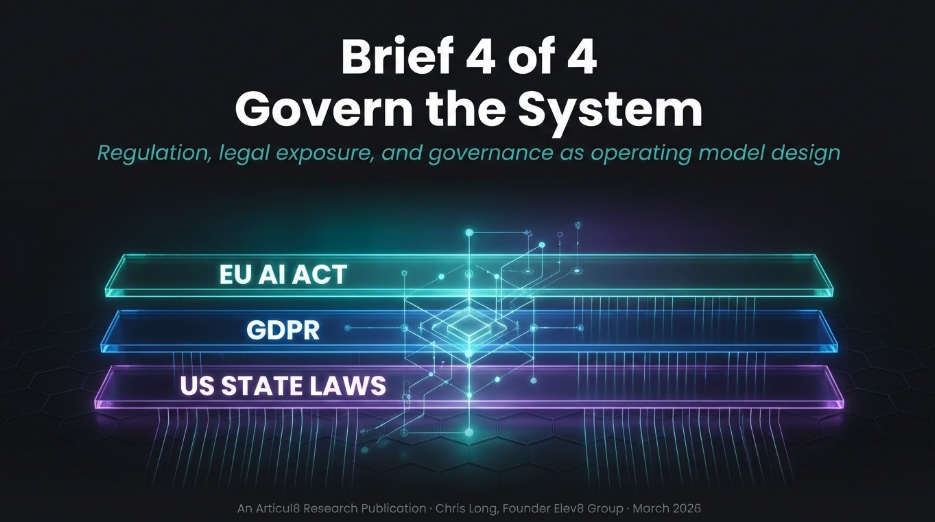
Brief 4 — Govern the System — maps the regulatory architecture and builds the governance framework by spectrum position.
The window to lead this is open — but not permanently. The HR leaders and functions that define what AI-native operating models look like will set the standard that others follow. That requires moving from adoption thinking to architecture thinking — now, not after the next planning cycle.
The Articul8 AI and HR Operating Model Series
This Note is the entry point into a four-brief research series drawn from a Master Research Paper synthesising thirty-two sources across consulting research, technical literature, practitioner artefacts, and regulatory frameworks. Each brief takes one dimension of the structural reconception argument and develops it into a fully operational, evidence-grounded guide for senior HR leaders.
Brief 1 — Understand the Disruption — Why agentic AI is not automating HR — it is restructuring what HR is for.
Brief 2 — Assess Your Position — The three-layer gap and what it actually looks like from the inside.
Brief 3 — Design the Response — The task-calibrated human-machine spectrum and the workflow redesign imperative.
Brief 4 — Govern the System — Regulation, legal exposure, and governance as operating model design.
Research Briefs

Visual Framework
The Task-Calibrated Human-Machine Spectrum: A single-page visual model for determining where human judgment remains essential, where it can be augmented, and where it can be delegated to intelligent systems. Derived from Brief 3.
Research Notes
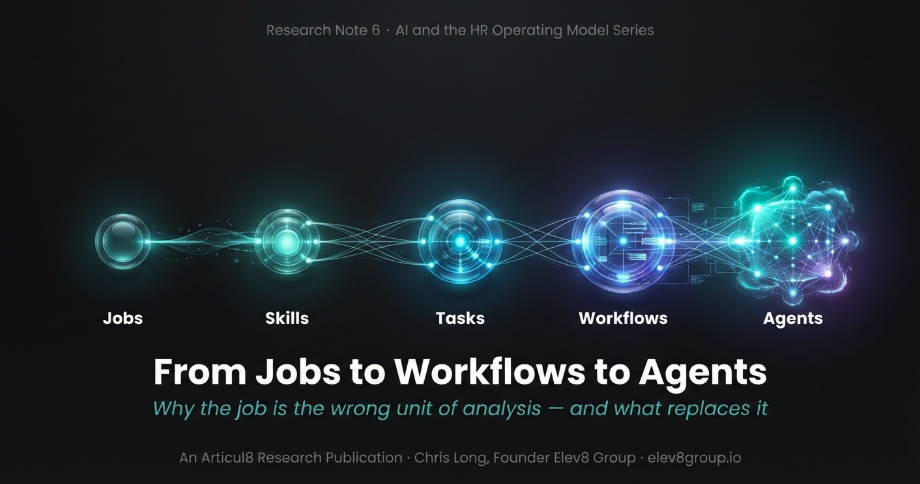
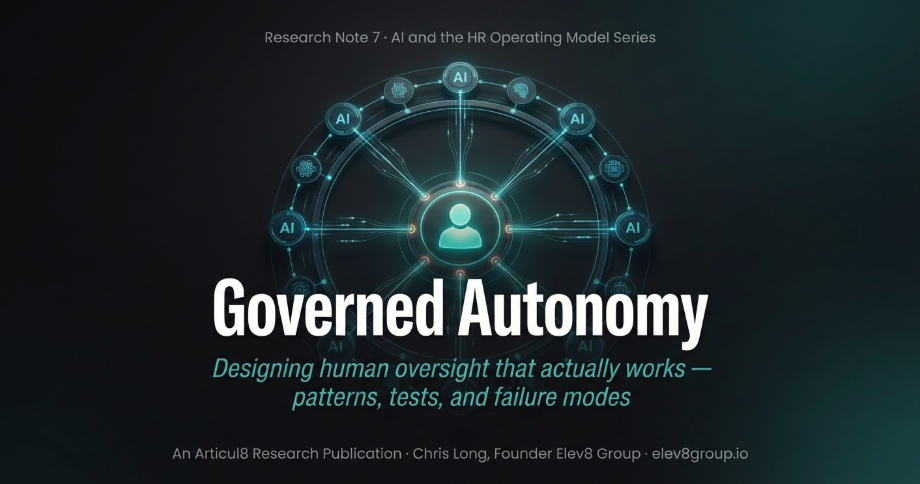
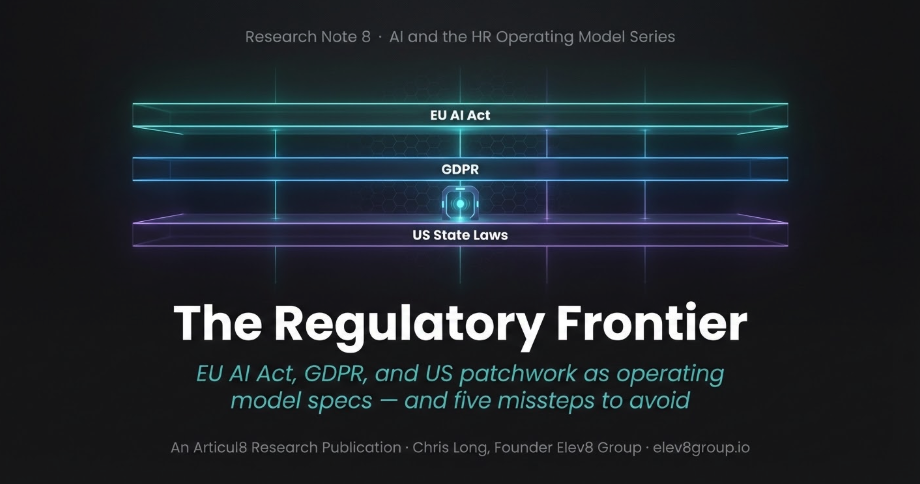

The Full Research
How is Artificial Intelligence Reshaping the HR Operating Model? Articul8 Master Research Paper · 13,700 words · 32 sources · March 2026
This series is derived from a full Master Research Paper — the source document from which every Brief, Note, and Framework in this ecosystem was built. Complete the form below to download.
This research was produced under the Articul8 brand — the research and vendor intelligence engine of Elev8 Group. All research is independently produced.
Signal → Clarity → Decision → Action